After Fidel by Brian Latell
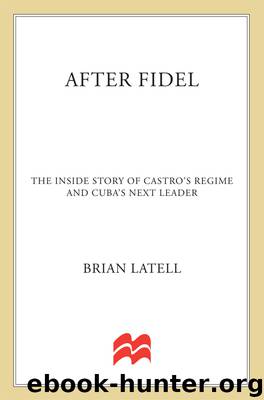
Author:Brian Latell
Language: eng
Format: epub
ISBN: 9781466885912
Publisher: St. Martin's Press
CHAPTER SEVEN
My Job Is To Talk
Dozens of squat, glass-sheathed office buildings have sprouted in recent years along the burgeoning high-tech corridor in Washington’s Northern Virginia suburbs, many of them housing government agencies and contractor firms engaged in intelligence and security work. One of the most nondescript is the headquarters of the Foreign Broadcast Information Service, America’s oldest civilian foreign intelligence organization. FBIS was founded in February 1941 and was already hard at work for nearly a year and a half when President Franklin Roosevelt established the Office of Strategic Services (OSS), the parent of today’s CIA.
With a network of bureaus, most of them in cooperating foreign countries, FBIS monitors foreign radio and television broadcasts in more than sixty languages. Known to intelligence analysts as Fibiss, it is small, unmysterious, and operates without any covert trappings. Transcribing and translating Japanese broadcasting before Pearl Harbor, the first generation of its propaganda analysts did not anticipate the attack any better than others in the U.S. government. They did report, however, that Tokyo had become more “hostile and defiant.” That was one of the important clues that went unheeded.1
FBIS is exceptional among American intelligence collection activities because the information it gathers every day of the year is unclassified, plucked from the world’s open air waves. Its modest annual budget would probably be consumed in less than a week by any of the larger agencies. Spies, reconnaissance planes, satellites, eavesdropping and other technical systems absorb the lion’s share of the approximately $40 billion spent every year on intelligence activities. But the information this unheralded little operation acquires has often been more valuable to intelligence analysts than the top secret, ultra-sensitive reporting from the bigger, more glamorous collection programs.
FBIS was never more essential than during the Cold War. The Soviet Union, its Eastern European satellite countries, and Mao’s China were “hard” intelligence targets or “denied areas,” where espionage and other covert collection was difficult and dangerous. Spies and eavesdropping systems can be neutralized, sensitive installations concealed from overhead reconnaissance systems, but governments in those hard target countries had to communicate openly with their own people, and they beamed large volumes of propaganda to foreign audiences they wanted to influence.
With that much to monitor, FBIS collection never flagged. Transcripts of radio programming from targeted countries reached analysts almost in real time, and in a steady flow. It was important to know what Soviet Politburo members were saying, what new communist party statements and ideological tracts portended. This open source information filled gaps about political issues, policymaking, economic, and military developments, and critical leadership dynamics in countries that were otherwise largely impervious to outside observers.
Cuba gradually became another of those denied areas after the Castro brothers’ victory. With the Soviet intelligence and military assistance that Raul requested in April 1959, Cuban intelligence and counterintelligence capabilities steadily improved. Well-placed and reliable covert sources who had provided information to the CIA chose to go into exile rather than run the risk of staying on the island in the role of traitors to the revolution.
Download
This site does not store any files on its server. We only index and link to content provided by other sites. Please contact the content providers to delete copyright contents if any and email us, we'll remove relevant links or contents immediately.
Waking Up in Heaven: A True Story of Brokenness, Heaven, and Life Again by McVea Crystal & Tresniowski Alex(37938)
Still Foolin’ ’Em by Billy Crystal(36482)
Cecilia; Or, Memoirs of an Heiress — Volume 1 by Fanny Burney(32726)
Cecilia; Or, Memoirs of an Heiress — Volume 2 by Fanny Burney(32092)
Cecilia; Or, Memoirs of an Heiress — Volume 3 by Fanny Burney(32069)
Fanny Burney by Claire Harman(26737)
Empire of the Sikhs by Patwant Singh(23211)
We're Going to Need More Wine by Gabrielle Union(19190)
Hans Sturm: A Soldier's Odyssey on the Eastern Front by Gordon Williamson(18729)
Plagued by Fire by Paul Hendrickson(17545)
Out of India by Michael Foss(17029)
All the Missing Girls by Megan Miranda(16754)
Cat's cradle by Kurt Vonnegut(15569)
For the Love of Europe by Rick Steves(14954)
Pimp by Iceberg Slim(14805)
Molly's Game by Molly Bloom(14267)
Bombshells: Glamour Girls of a Lifetime by Sullivan Steve(14227)
Leonardo da Vinci by Walter Isaacson(13535)
4 3 2 1: A Novel by Paul Auster(12629)
